
Actress Tamannaah Bhatia has been appointed as the brand ambassador for Karnataka Soaps and Detergents Limited (KSDL), the makers of Mysore Sandal Soap, sparking controversy over the choice of a non-Kannada speaking actor. The government defends the decision as a business strategy to boost sales outside Karnataka.

Foreign investors pulled out Rs 17,955 crore (Rs 2 billion) from Indian equities in the first two weeks of this month, taking the total outflow to Rs 1.6 lakh crore (Rs 18.4 billion) in 2025.' This sharp withdrawal follows a net outflow of Rs 3,765 crore in November, extending the pressure on domestic equity markets.

Indian equities declined on Friday, with the benchmark Nifty posting its worst weekly fall since September, as foreign investor sentiment remained weak amid tepid earnings growth and little progress on the India-US trade front.

'For those in for the long haul, this is a God-given opportunity.' 'Your market is falling despite strong fundamentals, and such a clear roadmap has been announced.'

Makers of spirits, beer, and wine are working to identify new markets of growth as two of the industry's biggest liquor markets, Maharashtra and Telangana, remain embroiled in taxation and payment issues.

Despite a 2.8 per cent fall in 2025 volumes, Mercedes-Benz India reported its best-ever revenue and profitability, led by top-end models, AMG growth and higher BEV mix.

Canadian firm Manulife and Mahindra & Mahindra (M&M), an Indian automaker with interests in financial services, have signed an agreement to form a 50:50 life insurance joint venture (JV) with a total capital commitment of up to Rs 3,600 crore each totalling Rs 7,200 crore.

Domestic equities surged on Tuesday, posting their best single-day gains in more than eight months after a long-awaited trade deal between India and the US. The deal, which lowered tariffs on Indian goods to 18 per cent from 50 per cent, significantly improved investor sentiment and lifted a key overhang for the market.

Finance Minister Nirmala Sitharaman on Sunday announced an increase in the Securities Transaction Tax (STT) on Futures and Options trade with a view to discouraging small investors from speculative trading in derivatives, which led to a sharp decline in the stock market.

The rupee witnessed a volatile trading session and settled for the day on a slightly lower note, down 1 paisa at 90.66 against the US dollar on Monday, as traders assessed the details of the India-US interim trade framework.

Foreign investors have pulled out Rs 11,820 crore ($1.3 billion) from Indian equities in the first week of this month, primarily driven by the sharp depreciation of the rupee. This sharp withdrawal follows a net outflow of Rs 3,765 crore in November, further pressuring markets.

A pickup in freight rates, rising fleet utilisation and a long-awaited replacement cycle are breathing fresh life into India's commercial vehicle (CV) market, strengthening the investment case for Tata Motors' CV arm (TMCV). Despite a broadly steady December quarter (Q3) performance, brokerages remain divided on whether the upswing is strong enough to offset margin pressures.

Foreign investors fled Indian equities in 2025 at a scale never seen before, pulling out a record Rs 1.6 lakh crore (USD 18 billion) as volatile currency movements, global trade tensions, especially potential US tariffs, and stretched valuations eroded risk appetite, though flows are expected to turn sustainably positive in 2026.

2025 marked a shift in investor preference when it comes to MF schemes.

'This is not just a cosmetic refresh,' said Suhas Rajkumar, founder and chief executive officer of Simple Energy. 'We have re-engineered the battery integration, made the scooter lighter, improved performance and expanded the portfolio so customers can choose based on real usage needs.'

Bihar Chief Minister Nitish Kumar has allocated portfolios of newly created departments among ministers, keeping Civil Aviation with himself, an official notification said.

Shares of Reliance Industries Limited (RIL) tumbled on Tuesday, posting its biggest single-day decline in 19 months, amid controversy over its purchase of Russian oil and profit-booking after recent gains.

Shares of brokerage-related companies nosedived 18 per cent on Sunday after Finance Minister Nirmala Sitharaman proposed raising securities transaction tax on commodity futures to 0.05 per cent from 0.02 per cent in the Union Budget 2026-27.

Homegrown FMCG player Emami Ltd on Monday reported a 29.7 per cent decline in consolidated profit after tax at Rs 148.35 crore in the second quarter ended September 30, 2025, impacted by temporary trade disruption in expectation of GST rate cut and excessive rains affecting certain product categories.

Mutual fund industry extended its bull run in 2025, adding a staggering Rs 14 lakh crore to its asset base and pushing total AUM to a record Rs 81 lakh crore by November, powered by surge in retail participation and record SIP inflows. Venkat Chalasani, chief executive officer of AMFI, told PTI that the industry's outlook remains positive, with steady SIP inflows continuing to offset foreign portfolio investor outflows and strengthening market resilience.

Mutual funds (MFs) - flush with cash amid record inflows in July - invested heavily in the Rs 25,000-crore qualified institutional placement (QIP) of India's largest lender State Bank of India (SBI). Fund managers acquired SBI shares worth Rs 10,200 crore last month, making the lender their biggest buy in July.

Most first-time investors may be better served by diversified options such as flexicap or multi-cap funds, which already hold pharma and healthcare stocks.

Driven by GST reforms, robust festive demand, and softening raw material prices, the FMCG industry expects volume-based growth, supported by a mid-single digit revenue rise and improved operating margins in the December quarter.

Since their inception, they have cumulatively distributed over Rs 26,700 crore to unitholders.

Ask rediffGURU Naveenn Kummar your insurance mutual fund and personal finance-related questions.

Ask rediffGURU Reetika Sharma your insurance, mutual fund and personal finance-related questions.

The consolidated net profit of Marico, the maker of Parachute coconut oil, declined 0.7 per cent in the second quarter (July-September) of 2025-26 (Q2FY26).

'We currently have new proposals worth Rs 1.48 trillion in the pipeline.'

Bharti Airtel on Thursday said that Bharti Telecom and Singtel have mutually agreed to amend the existing shareholders' agreement to better align with business requirements and governance standards, and that as part of the changes, Singtel has relinquished "several key reserved rights".

Ask rediffGURU Reetika Sharma your insurance, mutual fund and personal finance-related questions.

Benchmark stock indices Sensex and Nifty dived sharply by nearly 2 per cent on Sunday after Finance Minister Nirmala Sitharaman proposed a hike in the Securities Transaction Tax (STT) on derivatives. Reversing the early gains, the 30-share BSE Sensex plunged sharply by 2,370.36 points or 2.88 per cent to slide below the 80,000-mark at 79,899.42 in afternoon trade as the finance minister announced a hike in STT on futures contracts to 0.05 per cent from the current 0.02 per cent.

The idea, Shah explains, was to keep the discipline of a shared start, without asking anyone to participate in a religious act that wasn't theirs. The anthem, he felt, offered a "common minimum" that didn't privilege one faith over another: stand together, start together, get to work.

Electric vehicle (EV) penetration in the luxury car segment has seen a drop by nearly 3 percentage points in the GST 2.0 era with the internal combustion engine versions offering better total cost of ownership, according to industry players. While the trend is also visible in the mass market segment, it is the entry luxury segment that is witnessing a more marked shift towards internal combustion engine (ICE) vehicles as price difference between EV and ICE widened under the new GST rates.

From the 30-Sensex firms, Trent, Infosys, Bharti Airtel, Tech Mahindra, Bharat Electronics and Maruti were among the biggest gainers. However, State Bank of India, Kotak Mahindra Bank, Larsen & Toubro and Titan were the laggards.

Sunil Bharti Mittal-led conglomerate Bharti Enterprises and private equity firm Warburg Pincus will collectively acquire a 49 per cent stake in Haier Appliances India, the local unit of China's Shandong-based Haier group, for an undisclosed amount. The transaction, according to industry sources, values the company at about 15,000 crore.

NPS Vatsalya offers a disciplined investment avenue that parents can use to create intergenerational wealth by contributing even small sums.

Marico has entered into a definitive agreement with PVR INOX to buy its 93.27 per cent stake in Zea Maize Private Limited (ZMPL), which owns the gourmet popcorn brand 4700BC, in an all-cash transaction worth Rs 226.8 crore.
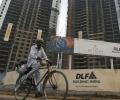
'The market today is different -- more mature and conducive. As a national player, you can't not be in Mumbai. And competition is always good.'

After two years of strong gains, smallcap stocks fell sharply in 2025, but the correction may be setting up opportunities for long-term investors.

Indian Hotels Company Ltd (IHCL) net profit rose 15 per cent in the second quarter after excluding the one-off exceptional gain of Rs 307 crore in the previous year. Net profit fell 45 per cent when compared with the previous year's earnings after including a one-off gain.
